
IEEE BENE Workshop
A workshop on the Beneficial Materials and Electronics (BENE): New Engineering for Humanity
Background
Electronics is both humanity's most powerful enabler and one of its most urgent environmental challenges. Various sensors, electronic including AI hardware, surgical implants, smart-grid controllers, and agricultural monitors all depend on electronics — yet the same industry generates a record 62 million tonnes (Mt) of e-waste per year, which is expected to rise to 82 Mt by 2030. With only 22.3% of this e-waste formally recycled, USD 91 billion worth of raw material gets wasted annually. Poor e-waste management externalises an estimated USD 78 billion in health and environmental costs every year. Upstream, semiconductor fabrication consumes about 800 million m³ of water and emits about 75 Mt CO₂e annually. The ICT sector alone now accounts for 1.7–4% of global GHG emissions, expected to grow rapidly with AI deployment. Moreover, materials marketed as biodegradable (leading to degradable or transient electronics), may still generate harmful degradation by-products that can be managed, but at a cost that makes it economically unviable to do so. A rethink about the way we develop and use electronics is critical now. The goal is not fewer electronics — it is better electronics, for people and planet.
IEEE BENE Workshop
The IEEE BENE Workshop is being proposed with a view to build the community, frameworks, tools, and standards needed to make ‘responsible electronics’ a technically verifiable route for future advances. IEEE BENE will address the full lifecycle of electronics, from materials and fabrication through use to end-of-life and reuse, making it relevant to virtually every IEEE Society, Council, and OU, as well as general research community. The BENE workshop is structured around six pillars: (a) Eco-Materials and AI-Driven Beneficial Materials Discovery; (b) Design for Circularity, Reuse and Repair; (c) Resource-Efficient Manufacturing (d) Brain-Inspired and Low-Power Computing; (e) BENE Score; (f) IEEE Standards Working Group. It is grounded in an established body of peer-reviewed research and designed to deliver several global firsts no existing IEEE initiative offers, including:
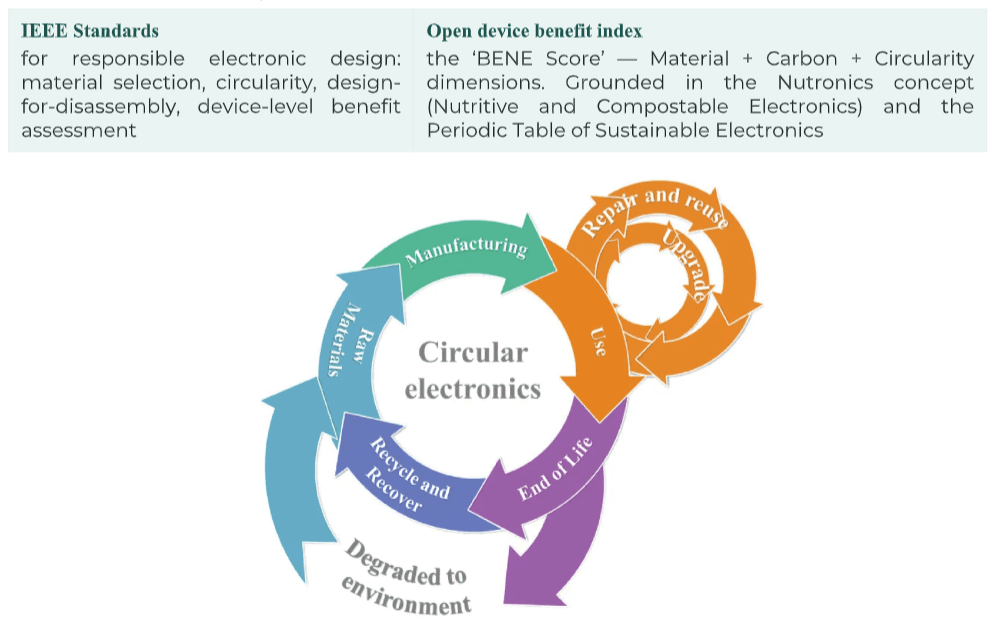
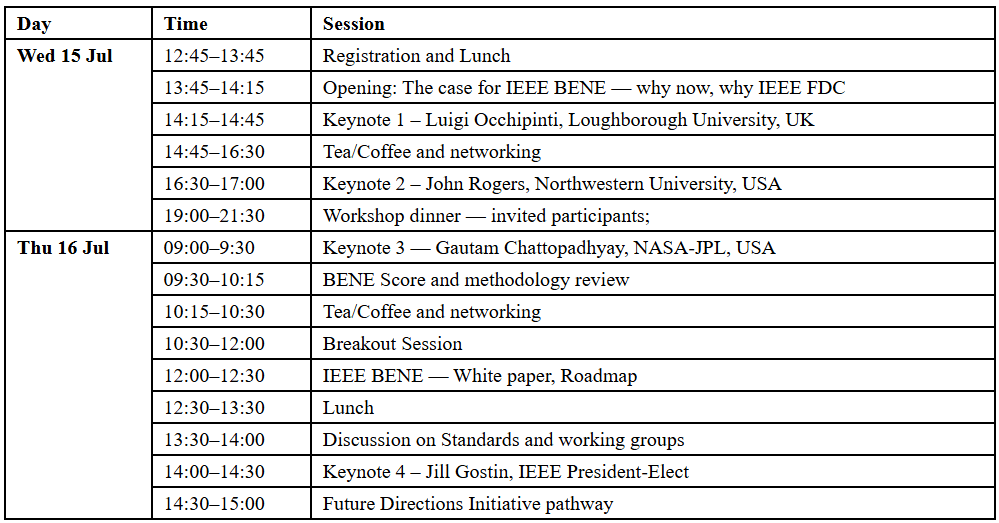
The one-day workshop is planned during 15-16 July 2026, immediately following IEEE FLEPS 2026 conference at Georgia Tech, Atlanta. The workshop is designed to bring together a deliberately broad community — IEEE leaders, materials scientists, engineers, policy experts, and outside voices from adjacent fields to define how the Society will own responsible electronics. IEEE FLEPS 2026 delegates are encouraged to participate in the IEEE BENE Workshop. The workshop is also expected to result in a combination of white papers, roadmaps, surveys, and reviews. These events will also help identify near-/mid-/long-term topics for standards. The tentative program for 15-16 July 2026 workshop in Atlanta is:
Sign up for the workshop here or by scanning the QR code below. Registration is free, but space is limited. If you are already registered for IEEE FLEPS 2026, you still need to complete the workshop registration.